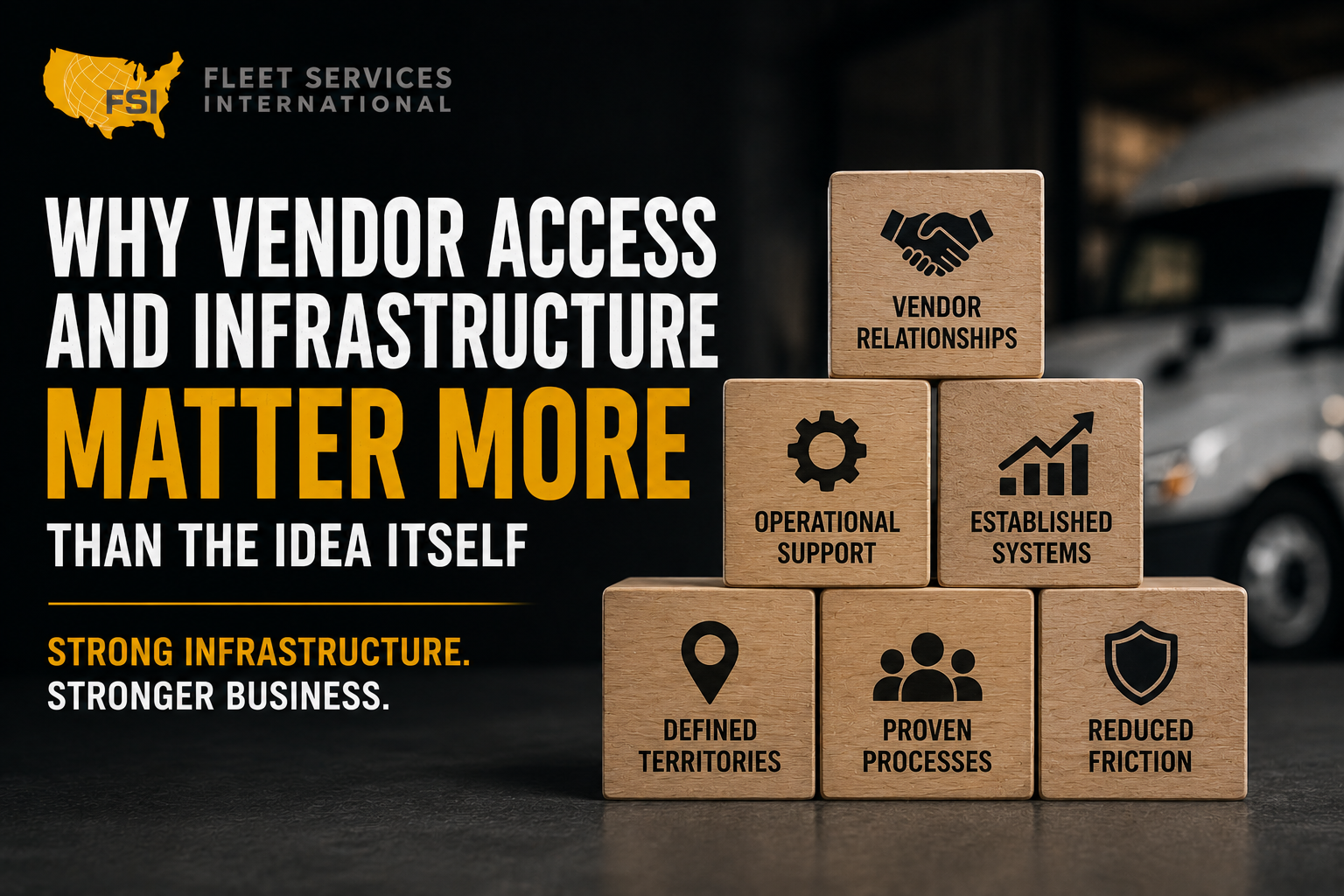

Why Vendor Access and Infrastructure Matter More Than the Idea Itself

Courtnee Boyd • May 8, 2026

Share this article

The businesses that scale fastest usually aren’t starting from zero

Most people evaluating business ownership focus on the wrong thing first.


They obsess over the idea.


What industry should I enter? What service should I offer? What business sounds exciting?


But ideas rarely determine whether a business succeeds long-term.


Infrastructure does.


A weak business with strong infrastructure will usually outperform a strong idea with no structure behind it.


That’s because businesses don’t operate on concepts—they operate on execution.


And execution becomes significantly harder when owners are forced to build every relationship, process, and operational system themselves.


This is especially true in service-based industries.


Without vendor access, pricing becomes inconsistent. Without operational support, growth becomes reactive. Without structure, owners spend more time solving logistical problems than building the business itself.


Most first-time operators don’t recognize this early enough.


They assume the challenge is getting customers.


In reality, the bigger challenge is creating an operation capable of supporting sustainable growth once those customers arrive.


That’s where infrastructure changes everything.


The right framework creates leverage.


Instead of spending years developing relationships and operational systems independently, owners can enter with a foundation already in place—allowing them to focus on leadership, execution, and growth.


This is one of the reasons structured models like FSI exist.


The value isn’t simply the business category itself. It’s the access, support, and operational positioning surrounding it.


Defined territories, vendor relationships, and established systems reduce unnecessary friction and create a more stable path toward growth.


That doesn’t guarantee success.


But it creates a significantly stronger starting position than operating without structure.


This type of opportunity is best suited for individuals who understand that scaling a business requires more than motivation. It requires systems, relationships, and operational consistency.


It is not for people looking for shortcuts or expecting the business to run itself. And it’s not for those who confuse independence with building everything alone.


The strongest businesses are rarely built around a single idea.


They’re built on the infrastructure that allows that idea to scale.

Recent Posts

By Courtnee Boyd May 22, 2026
Why hard work alone rarely creates scalable ownership
By Courtnee Boyd May 22, 2026
The businesses that last are usually solving necessary problems—not chasing trends
By Courtnee Boyd May 15, 2026
Not all structured opportunities are built the same
May 15, 2026
Why freedom without structure usually turns into pressure instead
By Courtnee Boyd May 8, 2026
Why building everything yourself sounds appealing—until the reality sets in
By Courtnee Boyd April 28, 2026
The decision mistake that creates problems before the business even starts
By Courtnee Boyd April 28, 2026
Why stability isn’t about luck—it’s about structure
By Courtnee Boyd April 28, 2026
Why the real decision isn’t brand vs freedom—it’s structure vs uncertainty
By Courtnee Boyd April 28, 2026
The market most buyers ignore—and why serious operators are paying attention
By Courtnee Boyd April 28, 2026
Why income replacement and long-term growth are not the same thing
Show More