In the world of logistics, construction, delivery, and field services, there is one golden rule that governs profitability:
"If the wheels aren't turning, you aren't earning."
For any commercial operation, the vehicle fleet is its lifeblood. Every hour a truck, van, or specialized vehicle sits idle due to maintenance or repair is an hour it is burning revenue. While many business owners view maintenance as a "necessary evil" and a "cost of doing business," the savvy managers and investors know that the scheduled maintenance cost is negligible compared to the unexpected downtime cost.
Whether you are an aspiring entrepreneur looking at the massive potential of a commercial service dealership, or a local fleet manager trying to squeeze more productivity out of your assets, you must understand the true, hidden costs of fleet downtime—and how the mobile model is flipping the script on productivity.
Calculating the True Cost of Downtime
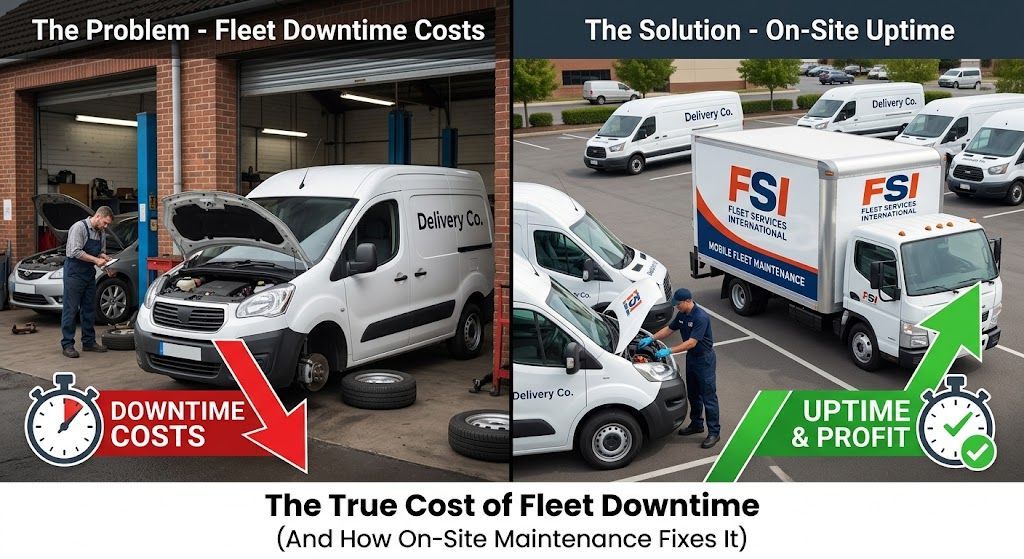
When a vehicle needs an oil change, brake work, or diagnostic check, most companies follow the traditional path: they have a driver take the vehicle to a brick-and-mortar repair shop. This process seems straightforward, but it triggers a cascade of hidden financial bleeds.
Let's break down the true
fleet downtime costs:
1. The Logistics Levy: Driving Time and Fuel
You aren't just paying the shop; you are paying to get to the shop. This involves fuel costs and increased wear and tear on the vehicle just to deliver it for service. If two employees are needed to drop off one truck (one to drive the truck, one to follow and give a ride back), the costs double immediately.
2. The Driver’s Debt: Wasted Wages
This is often the largest, yet most overlooked, cost. While that vehicle is sitting in the shop's waiting room or yard, what is your highly trained, salaried driver doing? Often, they are sitting there with it. You are paying productive wages for unproductive time. If your driver spends three hours managing the drop-off, waiting, and pick-up for a routine oil change, that’s $100+ (depending on their rate) down the drain before the mechanic even opens the hood.
3. The Grand Theft: Lost Revenue
What did that vehicle not do today? What customer delivery was missed? What job site was delayed? What service call was pushed to next week? When a vehicle is offline, its daily revenue-generating potential drops to zero. If your average box truck generates $1,500 a day in revenue, taking it offline for service costs you hundreds of dollars per hour in missed income.
The FSI Solution: Eliminating Downtime Entirely
This friction is where the Fleet Services International (FSI) dealership model thrives. FSI dealers aren't "just mechanics"; they are
productivity solutions experts for local businesses.
By offering
on-site fleet maintenance, FSI dealers remove all of the friction points we’ve discussed:
- Fuel Costs? The dealer’s mobile workshop drives to you, saving your fuel and vehicle wear.
- Wasted Driver Wages? Eliminated. Your drivers start and end their shifts as planned. FSI dealers service the vehicles when they are idle—at night, on weekends, or during loading/unloading windows.
- Lost Revenue? Eliminated. The vehicle is ready for its morning shift, ensuring its daily revenue-generating potential remains untouched.
For a local plumber with 15 vans, a utility company with a fleet of heavy-duty trucks, or an e-commerce contractor with dozens of delivery vans, this service is not just "convenient"; it is financially transformative.
Conclusion
The value proposition of mobile maintenance is undeniable because it is rooted in simple math: the service pays for itself by preventing the massive costs of downtime.
For the fleet manager:
This article shows you how to immediately claw back productivity and profitability that you are currently losing to traditional service methods.
For the potential business owner:
This is why the demand for FSI dealerships is skyrocketing. You aren't "selling oil changes"; you are selling increased uptime, driver productivity, and guaranteed revenue to local businesses. The service is so valuable that once a client experiences it, they rarely go back to traditional methods.
Are you ready to claim an exclusive territory and solve this critical problem for your local community?
Learn how to start your own high-demand FSI mobile fleet dealership today.